Hear from a Medical Office Administration grad
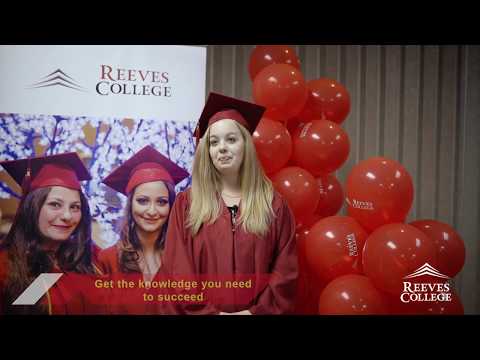
Kayla speaks about how she was able to apply her practical skills and knowledge.


Medical offices are fast-paced and rewarding workplaces in healthcare. As a medical office assistant, you will work on the frontline assisting doctors and other medical professionals.
Medical office assistants (MOAs) need relevant, up-to-date training to thrive in this growing industry. Reeves College's Medical Office Administration diploma program will train you in the clerical and medical skills necessary to run a modern medical office.
As a medical office assistant or medical receptionist, you will become an expert in assessing and prioritizing patient appointment requests, responding to patients' basic questions about their medical conditions and prescriptions, and administering medical billing software. Take medical office assistant courses in keyboarding, medical transcription, medical language, and more during this hands-on program.
During your program, you will also receive Standard First Aid and CPR training and certification. Before you graduate, you will put your skills into practice during a 100-hour practicum in a medical office.
ADMISSIONS PREREQUISITES
All applicants must meet with an admissions representative in addition to ONE of the following criteria:
Standard Admission
Mature Admission
Students must meet ALL of the following criteria:
*Manitoba applicants must also have been out of school for one year in addition to the above.
PRACTICUM PREREQUISITES
Provide a completed immunization report showing current immunization and free of communicable diseases, including Negative TB skin test or chest x ray (form provided by college).
Note 1: Some hosts require a Criminal Record Check and the existence of a criminal record may result in a candidate being denied acceptance by a work experience site.
Note 2: students selecting the capstone project instead of practicum placement do not require an immunization report be provided to the college. However, non-immunized individuals may face employment limitations.
CERTIFICATION RECEIVED
Medical Office Administration Diploma
Study Medical Office Administration at Reeves College in Calgary, Edmonton, Lloydminster, and Lethbridge.
Kayla speaks about how she was able to apply her practical skills and knowledge.
This course presents the MS Outlook application interface, tools, and features. You will learn about the fundamentals of an e-mail application, scheduling, calendars, contact lists, creating, forwarding and managing messages. This course relies heavily upon hands-on practical activities that allow you to learn concepts by practicing them on a regular basis.
This course introduces the students to word processing with Microsoft Word. Relying heavily on a hands-on practical training approach, students learn by doing skills based simulations, training and assessments. Learners will focus on the core features of Microsoft Word such as proper document formatting, organization and editing using the tools and features of the ribbon. The course will then continue with more advanced topics such as working with tables, lists, objects, templates footnotes and endnotes and mail merges. Students will explore the collaboration features that allow users to share and collaborate on documents through the use of track changes, sharing and reviewing.
Relying heavily on a hands-on practical training approach, students learn by doing skills based simulations, training and assessments in Microsoft Excel. The course starts with an overview of spreadsheets and how to use the common features and functions of Microsoft Excel. The course then focuses on the core features of Microsoft Excel where students learn how to enter and format data and use the various functions and formulas to manage and manipulate data. The course continues with more advanced topics such as performing quantitative analysis with logical, lookup and various mathematical and financial functions. Depicting data visually is an important feature of Excel. Students will learn how to work with charts in Excel to produce a variety of different charts based on data housed in a spreadsheet. Finally, students will learn to handle large volumes of data with datasets and tables.
The workplace of the twenty-first century demands excellent communication skills. The focus of this course is on learning writing techniques that ensure effective business communication. Following the completion of this course, students will be able to achieve effective writing styles, apply skillful writing techniques used in business communications in today’s workplace. This includes communicating in teams using listening, nonverbal and meeting skills; planning, writing and reviewing various types of business messages; communicating effectively using memos, email, letters and instant messages; creating business reports and proposals; plan, writing and delivering oral presentations.
In this course, students will develop and essential English skills through review and application of basic grammar and punctuation principles necessary for successful workplace communication. Students will also learn to proofread business communication as a three-step process that includes reviewing copy once for format, once for content and mechanical errors, and once for references and numerical text. Throughout the process, students will learn and apply standard proofreading symbols.
Students will examine the necessities required for operating a smooth and efficient office environment. Topics covered include basic filing techniques, telecommunications, time management and organizational skills and the use of general office equipment. Students will also learn the techniques of both manual and computer based appointment scheduling by learning to assess and prioritize calls (telephone triage) to most effectively schedule the physician’s limited time.
This course builds on the skills learned in the Student Success Strategies course or its equivalent. It provides information on how to use the communication skills learned in order to make a successful presentation to a prospective employer. Students also learn how to uncover the hidden job market and identify employment opportunities. Self-assessment during this course allows students to identify their personal skills that are transferable to the workplace and to describe these skills to a prospective employer. Students may be videotaped during a mock interview and will participate in the analysis of their performance in the “interview”.
Students will be placed in actual work places related to their field of study and will be expected to act as a regular employee in order to gain the valuable real world experience that so many employers seek. Students are encouraged to find their own work experience placement; however, once placed, continuation in that placement is mandatory.